Stop Losing Thousands: The Certified 7-Step Industrial Scale Calibration Checklist for Flawless Accuracy
You check your inventory reports, and the numbers don't add up. Again. Those discrepancies often trace back to one overlooked issue: uncalibrated weighing equipment quietly draining your profits.
If you're using Industrial Scales in manufacturing, logistics, or food processing. Proper calibration separates profitable operations from ones hemorrhaging money through invisible measurement errors.
Key Takeaways
- Follow a certified 7-step calibration protocol to maintain accuracy and prevent costly measurement drift.
- Schedule calibrations annually at a minimum, more frequently for heavy-use environments.
- Avoid common mistakes like using the wrong weights, skipping documentation, and ignoring environmental factors.
- Maintain detailed records for NIST traceability and audit protection.
Why Your Scales Are Costing You Money
What common mistakes should be avoided? And why is regular industrial-scale calibration crucial for your business?
Suppose you brought that brand-new industrial digital scale you just installed. You notice that it's already losing accuracy. Factory calibration happens at the manufacturer's facility, not yours.
The variation in height, temperature, and gravitational pull implies the fact that what may have been calibrated at the factory does not match in your plant. All things that do not favor the accuracy of measurements are temperature variations, variations in humidity, forklift vibrations, dust, and even normal wear.
What Happens When You Skip Calibration
How can I ensure flawless accuracy when calibrating industrial scales? Your heavy-duty scales show numbers, so everything seems fine. But accuracy degrades gradually through electric shocks, mechanical impacts, and exposure to moisture and oils. By the time you notice, the damage is done.
A quarry weighing hundreds of loads daily loses substantial amounts annually from just one uncalibrated scale. Multiply that across all the industrial weighing systems in your facility, and the numbers become staggering.
Industrial Scale Calibration Checklist
Step 1: Set Up Your Calibration Environment
Place your scale on a stable, flat surface away from vents, doors, and vibrating machines. Use a spirit level to check its level. Avoid drafts and temperature changes, and keep it away from electronics that may cause interference.
Step 2: Choose the Right Certified Weights
Use certified weights matched to your scale's capacity, complete with documentation. For legal-for-trade use. Uncertified weights make calibrations invalid.
Step 3: Zero Out Your Scale Properly
Clear the platform on your industrial scale. Power it on and let it warm up as per the manufacturer's instructions. With nothing on it, press zero; the display must show steady zero.
Step 4: Calibrate Across Multiple Weight Points
Place the certified weight dead center on the platform and note the reading. Test portable or precision scales at min, mid, and max capacity. Wait for stability and take repeat readings for consistency.
Step 5: Check for Position-Dependent Errors
Place your test weight in the center, then systematically move it to each corner and edge position. All readings should match within tolerance. Significant variations signal load cell issues that calibration can't fix.
Step 6: Verify Linear Response
Test weights at several points across your capacity range. The scale's response should be perfectly linear. Deviations indicate non-linear behavior that affects real-world measurements.
Step 7: Document Every Detail
Record the date, technician name, environmental conditions, calibration weight serial numbers, initial readings, final readings, adjustments made, and next calibration date. This documentation provides NIST traceability and protects you during audits.
Determining Your Calibration Schedule
Annual calibration is the minimum for all industrial scales. High-intensity operations running continuous production need daily or weekly calibrations. Legal-for-trade applications and pharmaceutical manufacturing require frequent verification. General manufacturing typically works with monthly or quarterly schedules. Occasionally-used backup equipment might only need annual calibration.
If your scales drift out of tolerance frequently, increase your calibration frequency. Your equipment is telling you it needs more attention.
Five Calibration Mistakes That Cost You Money
- Using the Wrong Weights: Your calibration accuracy depends entirely on reference weights. Uncertified or damaged weights make your effort meaningless. Invest in properly certified weights.
- Skipping the Leveling Step: Every calibration requires leveling verification. Even slight angles impact accuracy. Use a quality level every time.
- Ignoring Your Environment: Calibrating near open doors or running equipment wastes time. Temperature shifts, humidity changes, and air pressure variations affect performance. Control these factors.
- Single-Point Calibration: Calibrating only at the midpoint misses non-linear behavior at the extremes. Test across multiple points to ensure accuracy everywhere.
- Poor Documentation: Skipping paperwork costs you during audits, inspections, and troubleshooting. Record everything systematically.
When to Bring in Professional Services
Complex industrial weighing solutions, large truck scales, and legal-for-trade applications require expertise you probably don't have in-house. If your scale consistently fails calibration or handles critical measurements where accuracy impacts safety or major financial decisions, professional service is risk management.
Moving Forward with Confidence
Every day you operate with uncalibrated equipment, you're accepting losses from inaccurate measurements, material waste, and regulatory risk. This 7-step checklist protects your profitability.
Control your environment, use certified weights, calibrate across your operational range, test for position and linearity errors, and document thoroughly. Start with annual calibrations and adjust based on usage intensity.
Stop accepting preventable measurement errors. Visit Prime Scales and buy trusted scales to run your operations smoothly without any delay or losing money.
Frequently Asked Questions
1. What can I do to make certain of perfect precision in the calibration of industrial scales?
Control the environmental conditions, load certified NIST weights that suit your capacity, and then carry out multi-point calibration throughout your working range and record all the measurements.
2. What are the certified procedures for scale calibration in industries?
These seven steps are the following: prepare the environment, choose certified weights, do a zero-point calibration, do a multi-point span calibration, check eccentricity, check linearity, and record.
3. What is the importance of normal industrial-level calibration in my company?
Calibration is done on a regular basis, ensuring that the drift of the measurement does not waste materials and also forfeits revenue, and also ensures that there is compliance with the regulations and that customers trust the accuracy of transactions.
4. What is the frequency with which industrial scales should be checked to prevent expensive mistakes?
The minimal calibration is annually, but high-use operations require more frequent verification with the usual manufacturing comparing calibration quarterly, depending on the usage behavior.
5. What are the similar pitfalls to avoid during calibration on an industrial scale?
Not to use uncertified weights, not to level properly, not to pay attention to temperature and vibration, not to calibrate in the middle of the way, and not to maintain sufficient documentation.
6. Where do I get certified industrial scale calibration services?
Find providers that are accredited to ISO/IEC 17025 certification and have NIST traceable standards, and offer full calibration of their equipment, which has a complete certificate of calibration with full traceability.
Recent Posts
-

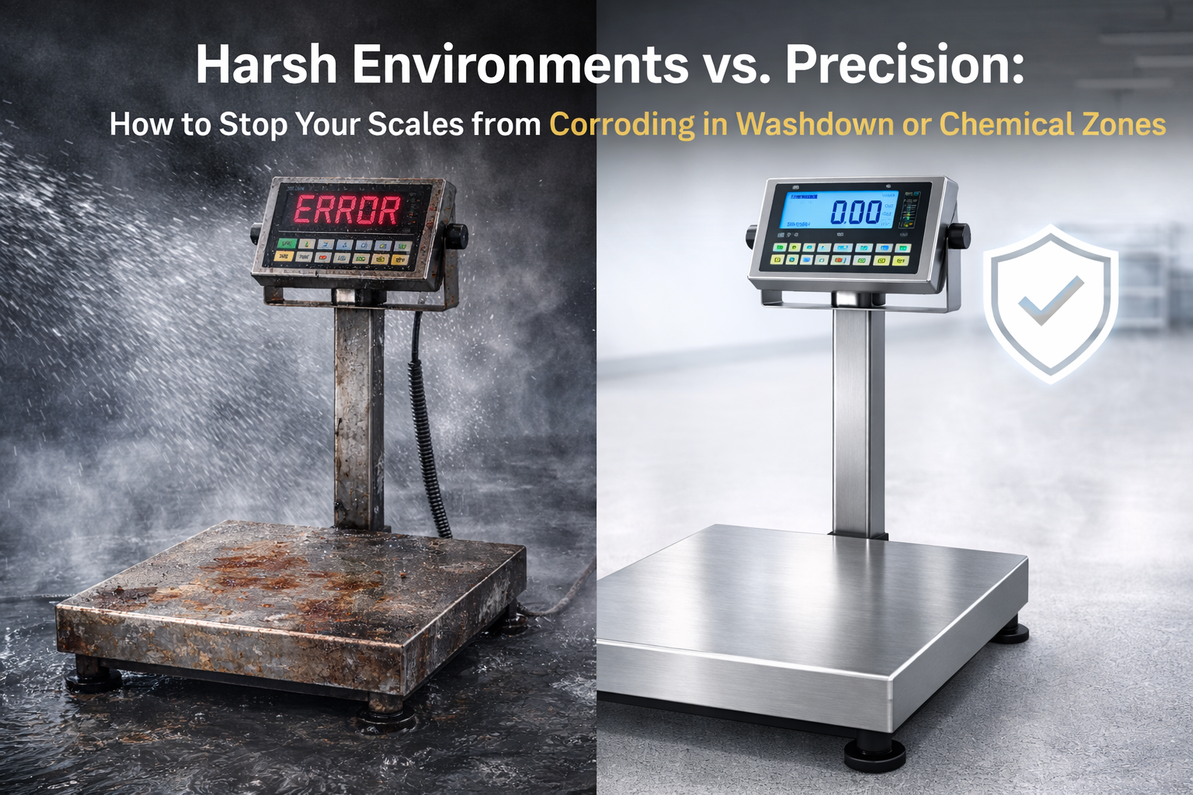
Harsh Environments vs. Precision: How to Stop Your Scales from Corroding in Washdown or Chemical Zones
Does your weighing equipment fail every few months? It is frustrating. You buy a new scale. It work …27th Feb 2026 -
What to Do When Your Industrial Scale Fails: Troubleshooting Guide
Have you ever experienced your weighing scale stop working in the middle of your shift? Nothing stop …27th Feb 2026 -
Everything You Must Know to Ensure Industrial Scale Compliance and Avoid Costly Fines
Did you know one bad scale reading can get you fined? It's true. Many businesses mess up their scale …3rd Feb 2026