Sick of Bad Readings? The Fast Guide to Fixing Faulty Medical Scales
You trust your clinic’s weight scale. Right up until it lies to you.
One reading says 165 pounds. An hour later, the patient steps up again… Now it's 172.
Faulty medical scale readings compromise patient care when uncalibrated load cells drift, or uneven surfaces shift weight distribution. Most inaccurate scale readings come from floor flexing, depleted batteries, or uncalibrated strain gauges. Verifying level surface placement, using NIST-traceable weights, and switching to high-capacity patient weighing scales restores clinic-grade accuracy.
We built Prime Scales because we kept seeing clinics lose patient trust over something completely preventable. I'm breaking down the truth about medical scale calibration, the math behind load cell degradation, and why "just replacing the batteries" is actually a trap.
Key Takeaways
- Fix the ground: Soft carpet or an uneven tile seam causes the vast majority of bad weight readings.
- Respect weight limits: Stop pushing standard scales past their max capacity unless you want to blow out the strain gauges.
- Never ignore low power: Weak batteries starve the circuitry of clean voltage long before the screen starts flashing.
- Keep a schedule: Test heavy-traffic patient weighing scales regularly with actual test weights.
Why Is Your Medical Scale Giving Inaccurate Readings?
Medical scales don't break in a flash. They drift silently.
A load cell loses sensitivity. The platform tilts by a millimeter. The software drifts 0.3% every month. And all this decreases the chances of accurate readings.
No error screen pops up to warn you.
Let’s imagine this situation in a busy clinic. A patient's chart says they gained eight pounds in three weeks. To which the nurse panics, and the patient feels guilty.
Then someone tests the medical weight scale with a calibrated standard. And you realize it’s been off by seven pounds for months.
False numbers lead to wrong drug dosages and false fluid tracking, and patients lose faith in your practice.
At Prime Scales, we audit hundreds of medical weighing scales every year.
Because the reality is that most "broken" scales aren't defective.
They just show wrong numbers because of bad floors and skipped maintenance.
What Causes Incorrect Weight Readings on Clinical Scales?
Here are the four mechanical errors sabotaging your numbers every day.
1. Uneven Surface and Carpet Flex
Put a scale on carpet or uneven tile, and your readings are instantly useless.
When the floor flexes, weight pushes sideways instead of straight down into the sensors.
Always place your scales on hard concrete, solid hardwood, or flat commercial tile.
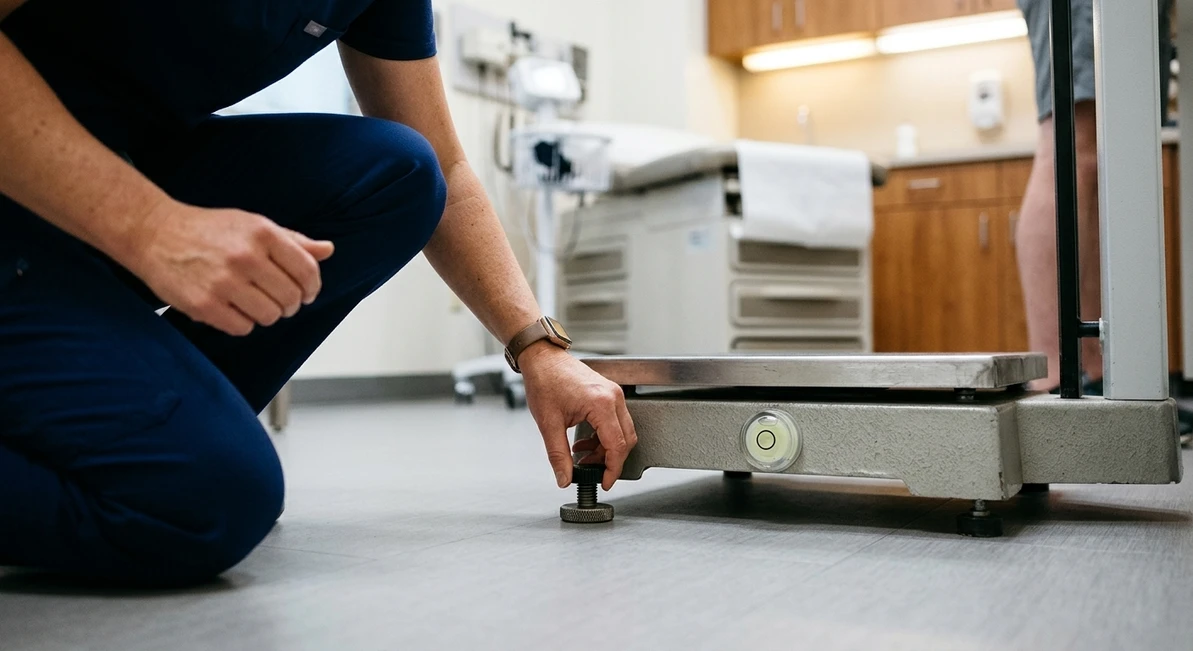
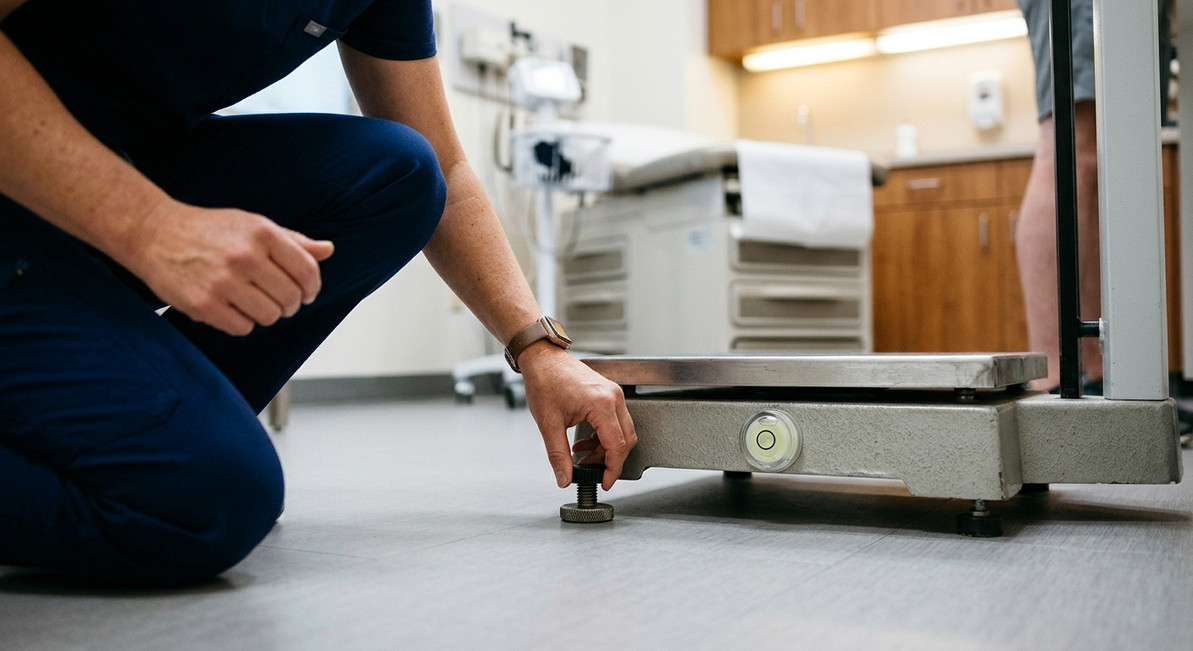
Check your built-in bubble level and adjust the feet. Never shove cardboard or shims under the base.
2. Battery Voltage Drop
A low battery doesn't just dim the screen display.
It starves the load cell circuit of steady voltage, causing wild sensor drift before any low-battery icon shows up.
Plug into AC wall power whenever possible. Or swap batteries on a strict monthly schedule.
3. Capacity Mismatch and Overloading
You wouldn’t drive a Ford Fiesta carrying a dump truck load. Yet clinics try to put a 350-pound standard scale under a 450-pound patient every single day.
Overloading a scale permanently crushes the internal strain gauges. Once those tiny sensors stretch past their yield point, they forget what zero looks like.
That’s why heavy-duty bariatric scales aren't a luxury upgrade. They’re a structural necessity. Big-capacity load cells absorb extreme weight without throwing off their calibration.
4. Severe Load Cell and Platform Damage
Think of a load cell as the nervous system of your scale. It translates physical gravity into electrical signals.
Moisture seeping into the housing, heavy drops, and years of pounding foot traffic wear those parts down.
If you step on the platform three times in a row and the numbers bounce around by three or four pounds, your internal bridge is fried. You can’t software-tweak a dead sensor back to life. You just have to swap it out.
How Often Should You Actually Calibrate Your Scale?
I want to be straight with you here: nobody wants to mess with calibration unless they have to. But factory calibration has an expiration date.
Temperature swings in the hallway, floor vibrations from slamming doors, and a thousand pairs of feet walking across the platform every week will slowly knock any scale out of alignment.
Here is what works in the real world:
- Busy clinics seeing 15+ patients a day: Give it a quick check every month and run a real calibration every quarter.
- Moderate offices seeing 5 to 15 people daily: Every three to six months keeps you safe.
- Low-traffic or specialty spaces: Once every six months is usually plenty.
Just remember that gear with weird weight distributions, like wheelchair-scale platforms or bariatric decks. They drift way faster. Write your tests down in the maintenance log so the compliance auditors stay happy.
The 60-Second Field Test to See If Your Scale Is Lying
Stop guessing if the numbers are real and run this quick check:
- The Zero Check: Clear everything off the deck, hit zero, and make sure it sits dead-flat at 0.0 lb.
- The Center Drop: Toss a certified calibration weight right in the middle. Does the screen match the weight? Good.
- The Corner Slap: Move that same weight to each of the four corners one by one. If the numbers spike or drop depending on where the weight sits, your frame is warped, or a load cell is toast.
What the Official Standards Actually Mean
There’s a huge gap between a quick morning check and an official audit.
Your clinic staff can run daily spot checks with a known weight just to catch gross errors. But your internal maintenance team or a visiting Biomedical Equipment Technician (BMET) needs to step in quarterly with certified weights to keep your sensors within a safe clinical tolerance.
When annual certification rolls around, a licensed technician with NIST-traceable weights signs off on your official paperwork.
The World Health Organization estimates that 80% of healthcare equipment failures are preventable. Regular inspection, calibration, and maintenance help keep your devices safe, accurate, and ready when patients need them.
The First Step to Fixing Your Scale Right Now
Stop trusting unverified numbers.
Walk over to your primary scale right now and look at the base.
Is it sitting flat on a hard floor? Check the bubble level.
If it's off-center, twist the feet until it sits dead center. It takes 30 seconds.
If your device still gives bad readings or hasn't been tested in six months, check out our medical scales for sale or contact Prime Scales to get your practice back to certified precision today.
Frequently Asked Questions
1. Why does my medical scale show different numbers every time someone steps on it?
That usually points to a flexing floor beneath the feet, a dying battery starving the board of steady voltage, or a worn-out load cell. Take the scale off the carpet, drop it on bare concrete, and test it with a known weight.
2. Does an uneven floor really mess up the reading that much?
Absolutely. Even a slight slope forces weight to shift sideways across the platform instead of straight down, throwing your numbers off by a few pounds instantly.
3. What should I do if my medical scale is not weighing correctly?
Level the platform using the threaded feet and test with a known weight. If it stays off, read our complete guide to medical scale maintenance & troubleshooting or call a certified tech.
4. Can cold temperatures ruin digital scale accuracy?
Yes. Big temperature changes shrink or expand metal sensors, shifting your scale's zero point. Keep scales in climate-controlled rooms.
5. Are bariatric scales more accurate than standard medical scales?
Bariatric scales use heavy structural steel and high-capacity sensors designed not to bend under heavy loads, preventing rapid calibration loss.
Recent Posts
-

Buying a Food Scale? Compare the Best Options for Every Food Business
Running a kitchen or bakery is hard work, and every single gram counts. If your scale reading is wro …29th Oct 2026 -
Sick of Bad Readings? The Fast Guide to Fixing Faulty Medical Scales
You trust your clinic’s weight scale. Right up until it lies to you. One reading says 165 pounds. An …29th Oct 2026 -
A Practical Guide To Medical Scale Maintenance & Troubleshooting
The display says 84 kg. The patient is actually 87! The nurse charts 84 because why would she doubt …6th Oct 2026