The Essential Maintenance Playbook: Troubleshooting Industrial Scale Errors in 2026
If your scale is giving wrong readings, your production will slow down, your team will keep on guessing. And every minute of downtime costs you more than anyone wants to admit. This is the exact moment most operations managers panic and call for a full replacement, when the real fix might take 20 minutes.
Certified Industrial scales are precision instruments. They work hard in rough environments. And when they fail, the root cause is almost always traceable. This guide gives you a straight-line path from "something's wrong" to "problem solved" without the guesswork.
Key Takeaways
- 80% of scale problems come from setup, wiring, or environment, not bad equipment.
- Small warning signs like drift and unstable readings show up before failure.
- A simple monthly check can prevent most production downtime.
- If you understand load cells and junction boxes, you control the outcome.
Why Industrial Scale Errors Happen
Most weighing errors aren't random. They follow patterns. And once you understand those patterns, you stop chasing symptoms.
The truth is, the majority of industrial weighing system errors come from three areas. These are :
- physical damage
- environmental interference
- improper setup
Each one shows up differently on your display. Each one has a fix.
The Most Common Error Triggers
Start here before anything else. These are the usual suspects:
- Overload errors: something exceeded the rated capacity, even briefly
- Zero drift: the scale no longer returns to zero after a load is removed
- Unstable or jumping readings: often caused by vibration or loose connections
How Load Cells Lose Accuracy
The load cell is the heart of any industrial digital scale. It converts physical weight into an electrical signal. When it fails, or starts to fail, your entire reading becomes unreliable.
Industrial scale load cell failure rarely happens all at once. You'll notice small inconsistencies first. Then bigger ones will appear by the time it's obvious. Because till then you'd have already shipped the wrong quantities or failed a compliance audit.
Strain Gauge Warning Signs
Strain gauge load cells have a thin resistive element bonded inside. Moisture, overloading, or physical shock can damage them without visible signs. Test each cell individually with a multimeter before assuming the whole system is bad.
Junction Box Failures
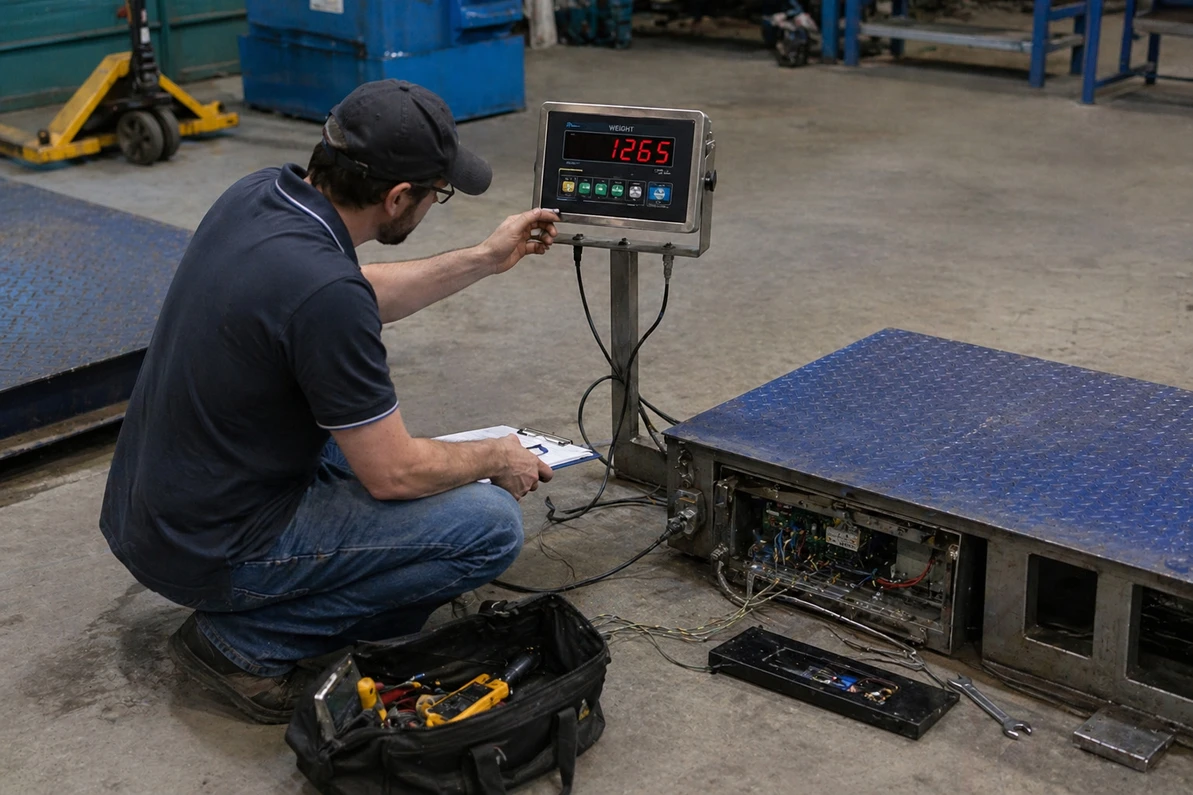
A junction box combines signals from multiple load cells into one clean reading. A summing card inside it balances those signals. If one load cell is weak, the summing card can't compensate forever. Check for corroded terminals, moisture ingress, and loose wiring here first.
What Causes Load Cell Reading Fluctuations?
Causes of load cell reading fluctuations almost always trace back to environmental interference. Vibration from nearby machinery. Wind shear from open dock doors or HVAC systems. Even temperature swings that expand and contract the scale platform.
Your digital weight indicator will show this as jittery numbers that never fully settle. The fix isn't replacing the load cell. It's addressing what's happening around the scale.
|
Symptom |
Likely Cause |
First Step to Check |
|
Readings jump constantly |
Vibration or wind shear |
Inspect the installation surface |
|
Scale won't zero properly |
Debris under platform or drift |
Clean feet, reset zero |
|
E1 or overload with no load |
Load cell wiring fault |
Check junction box terminals |
|
Readings drift over time |
Temperature or moisture damage |
Inspect strain gauge load cells |
|
Inconsistent across corners |
Summing card imbalance |
Test each load cell separately |
Predictive Maintenance For Weighing Systems
Reactive maintenance is expensive. You wait for a failure, scramble to fix it, and lose production time. Predictive maintenance for weighing systems flips that model entirely.
It means tracking small changes in your scale's behavior over time. Logging calibration data. Noting when zero drift starts creeping in. Watching for the early signs of industrial scale load cell failure before they become full breakdowns.
Simple Monitoring Routine
You don't need fancy software to do this. A basic log sheet works. Record your scale's zero reading each morning. Note any error codes you see. Flag when calibration starts drifting more than your tolerance allows.
Essential Maintenance For Industrial Scales
Preventive maintenance of industrial scales is the baseline. Every heavy duty scale needs it on a schedule, not just when something breaks.
Monthly Inspection Checklist
- Visual inspection: cracks in the platform, loose bolts, debris under the load feet.
- Cable check: look for pinched, frayed, or exposed wiring between load cells and the junction box.
- Zero and span calibration: verify the scale reads correctly at zero and at a known test weight.
You must understand tare weight.
Tare weight is the weight of the empty container or pallet. The scale subtracts this number to show the real product weight.
If the pallet gets heavier over time, your tare is no longer correct. If someone enters the wrong tare number, the reading will also be wrong. When tare is off, every net weight after that is wrong too.
Durable Industrial Weighing Solutions
Not all industrial weighing solutions are built for the same environment. A washdown-rated floor scale belongs in a food processing plant. A portable industrial scale works on a loading dock. The right match matters as much as the maintenance.
Visit Prime Scales to explore industrial weighing systems designed for real operational demands, from light manufacturing to heavy logistics.
An Honest Warning Before You Buy or Replace Anything
I want to be straight with you here. Industrial scales are excellent tools, but they're not perfect, and neither are the people selling them.
Here's what nobody tells you, even the best industrial weighing scale will underperform if it's installed on an uneven floor, near heavy vibration sources, or in a humidity-heavy environment without proper sealing. No amount of brand quality fixes a bad installation.
Also, some "industrial scales for sale" online look industrial but aren't rated for continuous heavy use. Check the IP ratings, NTEP certification and ask for load cell specifications. If a seller can't answer those questions fast, that's your warning.
Conclusion
Most industrial scale problems are solvable without replacing anything. The real skill is knowing where to look, and in what order. Start with the environment, then the wiring, then the load cells, and then calibration. Follow that sequence and you'll resolve 80% of errors before calling anyone.
Three steps to take right now:
- Print or save this troubleshooting sequence and give it to your maintenance team.
- Schedule a monthly inspection routine, even a basic one cuts downtime significantly.
- Explore industrial scales built for your specific environment before your next purchase.
The operations that run smoothest aren't the ones with the best equipment. They're the ones with the best maintenance habits.
Frequently Asked Questions
1. Does the floor slope affect the accuracy of my floor scale?
Yes, uneven flooring causes side-loading and forces load cells to measure off-axis. Level the platform immediately using the adjustable feet and a spirit level to restore vertical weight measurement.
2. Is it safe to pressure wash an industrial scale during facility cleaning?
Only if the scale carries a high-pressure washdown rating such as IP69K. Standard seals will fail under direct spray, allowing water to destroy the internal strain gauges.
3. Do I need a certified technician to calibrate my scale for internal inventory?
No, internal inventory tracking permits in-house calibration using certified test weights. You only need a certified technician for legal-for-trade scales where weight determines billing.
4. Can high heat from nearby machinery damage my load cells?
Yes, heat causes permanent metal expansion and calibration drift beyond repair. Install heat shields or specify high-temperature load cells if the scale must operate near furnaces or ovens.
5. Why does my scale display "Dashes" or an "L" error code?
This indicates a complete communication break between the digital indicator and the load cells. Check the main home-run cable for physical cuts, corrosion, or loose connections at the junction box and display.
Recent Posts
-
A Practical Guide To Medical Scale Maintenance & Troubleshooting
The display says 84 kg. The patient is actually 87! The nurse charts 84 because why would she doubt …6th Oct 2026 -
Buying a Food Scale? Here's How to Choose the Right One for Your Business
You’re wasting money in the kitchen if every time a cook over-portions meat or cheese, profits drop. …6th Oct 2026 -

How to Choose the Best Food Scale for Better Accuracy, Portion Control & Food Safety
You are losing product every single day, and you might not know it. A restaurant over-portions by ha …1st Sep 2026