How to Choose the Best Food Scale for Better Accuracy, Portion Control & Food Safety
You are losing product every single day, and you might not know it. A restaurant over-portions by half an ounce per plate. Multiply that across 200 plates daily. That is 6.25 pounds of product gone invisibly.
In a food processing facility, one miscalibrated scale ruins an entire batch. The right digital food scale is a core operational tool. This guide shows you exactly how to choose one and what happens when you don't.
Whether you manage a restaurant, bakery, or food production line, the wrong scale costs you product quantity, compliance risk, and reputation damage. Let's break it down plainly.
Key Takeaways
- A cheap scale that drifts will cost you more in waste than a quality one ever will.
- NTEP certification is legally required in many commercial transaction settings.
- Wash-down rated scales are non-negotiable in wet food processing environments.
- Smart weighing technology can connect to inventory systems and eliminate manual tracking errors.
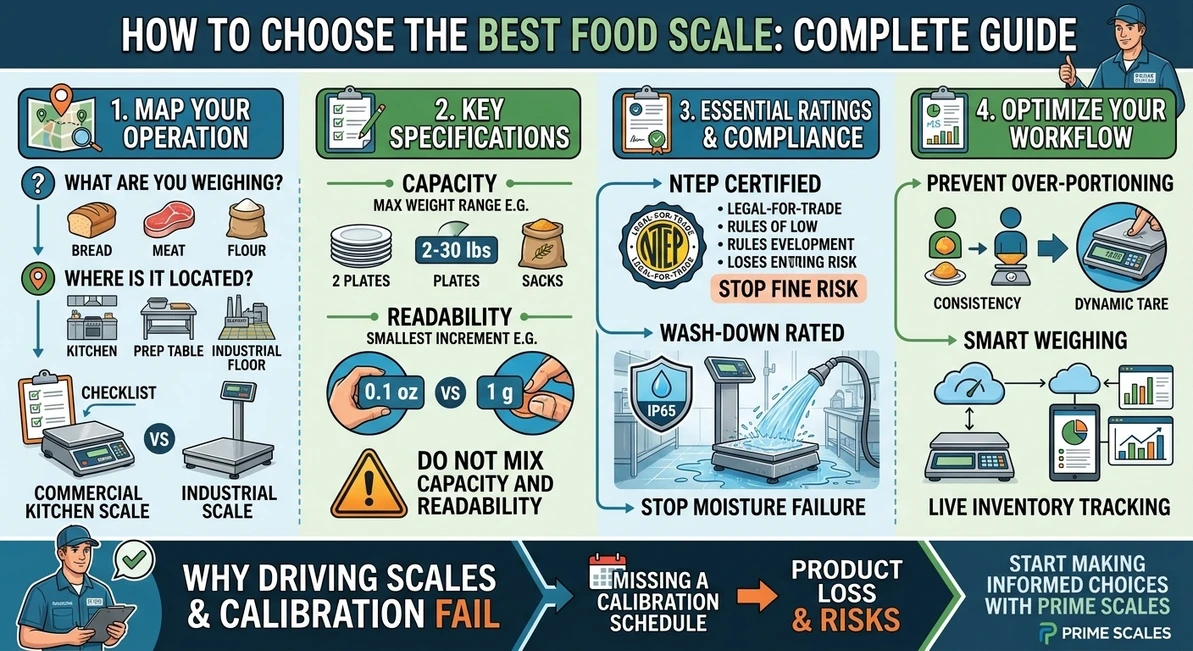
What Scale Type Actually Matches Your Operation?
Not every operation has the same needs. A bakery weighing flour by the gram has completely different requirements than a meat processing plant weighing bulk cuts. Buying the wrong category is where most businesses go wrong first.
Digital kitchen scales work well for restaurants and catering, light to medium loads, are portable, and fast. But they are not built for industrial environments.
Commercial Kitchen Scale vs. Industrial Scale
A commercial kitchen scale handles daily high-volume usage inside a professional kitchen. It tolerates heat, repeated cycles, and constant handling.
Industrial food scales are engineered for food processing facilities. They handle higher capacities, often integrate with production systems, and meet stricter environmental standards. These are not interchangeable.
Prevent Over‑Portioning in Commercial Kitchens
Portion control scales are built to deliver consistent weight results, plate after plate, shift after shift.
- Instant tare display keeps staff moving fast.
- Multiple unit switching supports different recipe requirements.
- Some models support Intelligent Portion Control Systems that track per-item averages over time.
If kitchen consistency is the main issue, the right scale is where the fix starts. Browse portion control scales built for commercial environments.
Don’t Mix Capacity and Readability
Most buyers focus on one spec and ignore the other, but both matter. Capacity is the maximum weight a scale can handle. Readability is the smallest increment it can measure.
A 30-lb scale with 0.1-oz readability works for plating, but bulk ingredient weighing may require 150 lb or more. Precision scales for spices or specialty production may require a readability of 0.001 g. Mismatching these specs to your workflow is a common and costly mistake.
Is NTEP Certification Important?
If your scale is used in a commercial transaction to sell food by weight, it likely must carry NTEP food scale certification. The National Type Evaluation Program confirms the scale meets Handbook 44 standards set by NIST.
NIST states that weights and measures laws govern over $7 trillion in U.S. commercial transactions each year. Using a non-certified scale can lead to fines, shutdowns, or license loss. Always confirm requirements with your state's weights and measures authority before buying.
Avoid Equipment Failure in High Moisture Environments
A scale that dies from moisture is a scale you replace twice. Food processing facilities deal with water, cleaning chemicals, and humidity constantly. A standard digital kitchen scale is not built for this. You need an IP65-rated scale minimum, sealed against direct water jets and chemical exposure.
Wash-down scales use sealed enclosures, stainless steel platforms, and components that survive daily sanitizing. Skipping this in a wet production environment is not a budget decision. It is a maintenance disaster in progress.
Can Your Scale Improve Inventory Management?
Modern smart food scales now connect directly to your kitchen software. They use digital weight tracking systems to record every item you weigh. This helps you see where food is being wasted right now. You won't have to wait for a bad inventory report at the end of the month.
Using automated ingredient measurement helps you spot trends before they cost you money. This is what digital food production management looks like in a real kitchen. It isn't just about high-tech gadgets. It is about finding silent losses and stopping them before they grow.
Which Scale Fits Your Operation?
|
Scale Type |
Best For |
Capacity Range |
Key Feature |
|
Digital Kitchen Scale |
Restaurants, cafes |
1–30 lbs |
Fast, portable, easy tare |
|
Portion Control Scale |
High-volume plating |
2–15 lbs |
Consistent repeat weighing |
|
Commercial Kitchen Scale |
Bakeries, catering |
10–60 lbs |
Durable, multi-unit display |
|
Wash-Down Scale |
Food processing, meat |
30–300 lbs |
IP65+ rated, sealed body |
|
Industrial Scale |
Large production lines |
100–1000+ lbs |
High capacity, integration-ready |
|
NTEP Certified Scale |
Retail, commercial sales |
Varies |
Legal-for-Trade compliant |
Why Even Quality Scales Fail Without Calibration
Even the best scale gives wrong readings without regular calibration. A precision food scale last calibrated six months ago in a busy kitchen. Most commercial scales need calibration every three to six months, more in high-use environments.
No scale survives consistent user error either. One overload event, an uneven surface, or ignored warm-up time can permanently damage the internal load cell. Train your staff and build calibration into your maintenance schedule
Still Unsure Which Scale Fits Your Operation?
Choosing the wrong scale wastes product and creates compliance headaches. The options are wide, and specs get confusing fast.
Prime Scales offers a focused range of commercial and industrial food weighing solutions. From portion control to wash-down environments. No pressure, just practical guidance to match the right tool to your specific job. Start there if you need a clear direction.
Conclusion
The right scale matches your environment, compliance requirements, and accuracy needs
First, audit your workflow and figure out what you weigh, how often, and in what environment. That alone eliminates most wrong choices. Second, check your legal requirements. If you sell food by weight, NTEP certification is likely mandatory. Third, build a calibration schedule now. Accurate scales drift without it.
Businesses that invest in proper weighing equipment see less waste, more consistent product, and fewer compliance issues. It starts with choosing the first time correctly.
Frequently Asked Questions
1. What type of food scale is best for restaurants and commercial kitchens?
A stainless steel portion control scale with a high IP rating is best. It should be fast, easy to sanitize, and durable enough to handle constant use during a busy lunch rush.
2. Do I need an NTEP-certified food scale for my business?
Yes, if you charge customers based on the weight of the food. This includes frozen yogurt shops, delis, and salad bars. It ensures your business stays compliant with weights and measures laws.
3. Can digital food scales track weight data and improve inventory management?
Modern smart scales connect to software to log every measurement. This data helps you see exactly how much product is being used, allowing for tighter inventory control and less waste.
4. Why is my food scale giving incorrect readings, and how can I fix it?
Incorrect readings usually come from low batteries, uneven surfaces, or "drift" over time. You can fix this by replacing the batteries, leveling the scale, or using a calibration weight to reset it.
5. What features should I look for when buying a professional food scale?
Look for a fast response time, a clear backlit display, and a "Tare" function. For high-volume areas, prioritize wash-down capabilities and an AC adapter so you never run out of power.
Recent Posts
-
A Practical Guide To Medical Scale Maintenance & Troubleshooting
The display says 84 kg. The patient is actually 87! The nurse charts 84 because why would she doubt …6th Oct 2026 -
Buying a Food Scale? Here's How to Choose the Right One for Your Business
You’re wasting money in the kitchen if every time a cook over-portions meat or cheese, profits drop. …6th Oct 2026 -

How to Choose the Best Food Scale for Better Accuracy, Portion Control & Food Safety
You are losing product every single day, and you might not know it. A restaurant over-portions by ha …1st Sep 2026