Buying a Food Scale? Here's How to Choose the Right One for Your Business
You’re wasting money in the kitchen if every time a cook over-portions meat or cheese, profits drop. A cheap or broken kitchen scale is usually why.
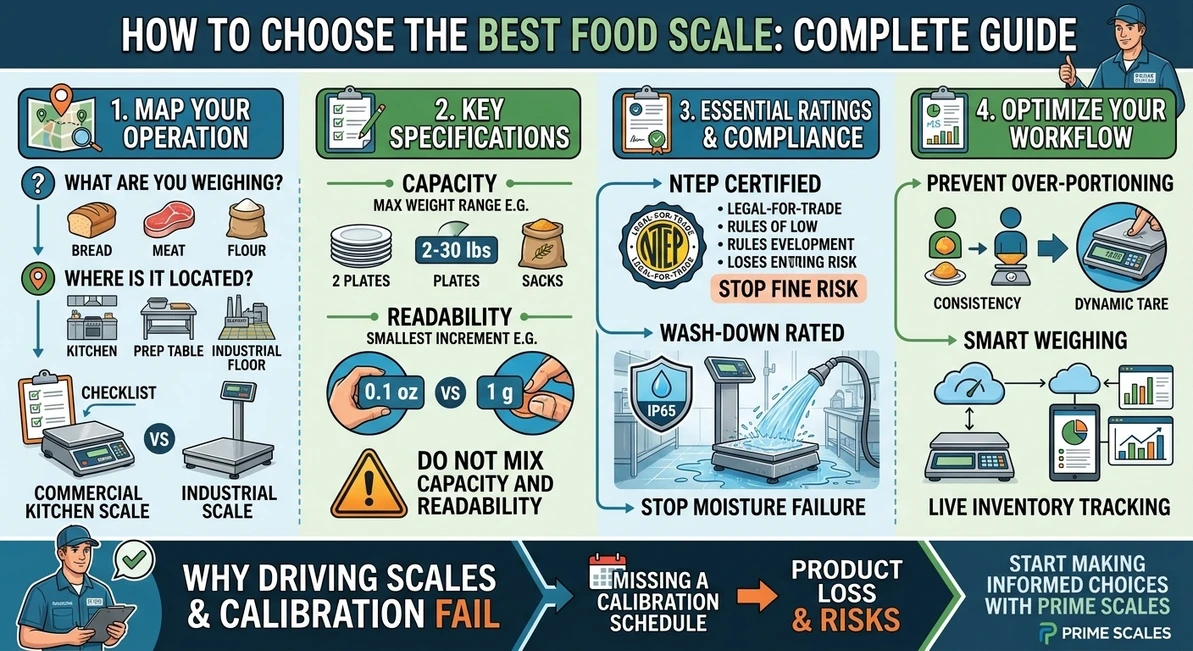
The right commercial food scale gives you accurate weight readings within 1 gram. It needs a suitable capacity, easy operation, and a low-maintenance design that handles busy dinner rushes. Skip flimsy home scales. Choose a durable commercial kitchen scale built for daily prep work.
We built the PS-FSS Bench Portion Control Scale because we kept seeing kitchens lose profit over inconsistent measurements. I'm breaking down the truth about scale reliability, the math behind weighing accuracy, and why "bigger platform equals better" is actually a trap.
Key Takeaway
- Match capacity to your menu: a scale rated 3 to 5 times your heaviest item gives the best readings.
- Sealed load cells stop drift: they keep measurements steady through long, hot shifts.
- NTEP certification: only required when you sell products by weight directly to customers.
- Stainless steel and IP65 waterproofing: to keep scale last 7+ years in tough kitchen conditions.
Why Does Your Current Scale Keep Lying to You?
Most food scale accuracy issues start with rough kitchen use.
I have seen a brand-new digital portion control scale fail in two months. A line cook slammed a heavy metal pan down. The internal sensor cracked. Nobody noticed until meat costs skyrocketed.
Reliable performance means your scale stays steady all day. If a scale reads 150 grams at noon and 158 grams at night, it is broken. That drift adds up to free food walking out your door.
To stop inaccurate readings, look for sealed parts and a bright digital display. If your unit drifts after warming up, replace it immediately. Precise portion measurements protect your margins.
What Capacity and Readability Do You Actually Need?
Many buyers pick huge scales thinking bigger is safer. That is a mistake.
The Capacity Trap
A giant commercial weighing equipment setup sounds great. But if you only weigh small burger patties, you are working in a blind spot. The scale readability on tiny portions will be poor.
- Small portions on huge scales cause calibration issues
- Big units struggle to show small 1-gram changes
- Your maximum weighing capacity should match your actual menu items
Pick the Right Platform Size
Large surfaces gather grease, flour, and water. A compact platform size keeps your prep table clean.
At Prime Scales, we build our commercial portion control scale options for real counters. A food scale for portion control with a 200mm base handles almost every daily job.
Is an NTEP Certified Food Scale Worth the Extra Cost?
Here is my honest take: most restaurants do not need an NTEP-certified food scale.
You only need a legal-for-trade food scale if you charge customers directly by weight. Delis, butcher shops, and candy stores must have them by law.
If you only use a restaurant food scale in the back kitchen for recipes, do not pay for that badge. Spend that money on better water protection instead.
What Features Make a Scale Worth Buying?
Use this quick food scale buying guide checklist before you spend anything:
Build Quality and Water Defense
A waterproof food scale with an IP65 rating easily survives wet wash stations.
- A stainless steel food scale stops rust from vinegar and salt
- Plastic bodies crack near hot grills and fryers
- Smooth metal cleans up in seconds after messy shifts
Fast Operation on the Line
Speed matters during a rush.
- One-touch zeroing resets bowls in one tap
- A tilted digital food weighing scale screen stops misreads from standing angles
- Large commissaries can add an automated portion control scale or automated ingredient weighing systems
How Much Money Does Scale Error Actually Waste?
The National Restaurant Association found that portion errors cost operators 4% to 6% of yearly food revenue [source: restaurant.org]. That is not pocket change.
"Most chefs blame food vendors when meat costs jump," notes kitchen expert Chef Marcus Webb. "Most of the time, the real problem is an old scale that nobody has checked in years."
Scale Type Comparison
|
Scale Type |
Typical Capacity |
Accuracy Level |
Water Protection |
Expected Lifespan |
|
Budget / Home |
5 kg |
1g - 2g |
None |
1 Year |
|
Mid-Grade |
15 kg |
0.5g - 1g |
Splash Only |
3 Years |
|
Commercial Grade |
30 kg |
0.1g - 0.5g |
IP65 Waterproof |
7+ Years |
When a Good Scale Won't Fix Your Food Costs
A great scale cannot fix sloppy kitchen habits.
If cooks guess ingredient amounts instead of using the scale, food costs still rise. If staff never zero out heavy bowls, portions stay wrong.
Even the best scale will fail if someone drops it or leaves wet flour underneath the platter. Equipment is only as good as the team using it.
How to Choose Your Next Scale in 3 Steps
Do not overcomplicate this choice. Follow three basic rules:
- Find your heaviest prep item and pick a scale rated 3 times higher.
- Make sure it has an all-metal body and sealed buttons.
- Check our list of the best commercial kitchen scale models to match your prep space.
Conclusion
Using the right scale will help you manage your food costs and ensure the profitability of your kitchen. The good scales will make your preparations quick, easy, and accurate.
Step one is to test your scale with a test weight five times in succession. Step two is to discard any unit that varies by more than 2 grams. Step three is to purchase a durable replacement.
Frequently Asked Questions
1. How often should a commercial food scale be calibrated?
Once a week if heavily used. Once a month if the scales are lightly used. Always recalibrate them immediately if the scales are accidentally dropped or hit by something or have been relocated, using certified calibration weights.
2. Are stainless steel food scales better for commercial kitchens?
Yes, always. Stainless steel resists rust from salt, acids, and sanitizers. They don’t deform when exposed to heat. Plastic deforms much faster under similar conditions.
3. How accurate should a commercial food scale be?
With an error of less than 1 gram for weighing portions of meat and produce. Less than 0.1 gram for baking and measuring spices in small-batch dishes.
4. Why is my food scale giving inaccurate readings?
Make sure you've checked these four factors: uneven weighing platform, air vents near the scale blowing on the platform, food bits stuck under it, and batteries.
5. What should you look for when buying a commercial food scale?
It should be IP65 waterproof, made of stainless steel, have one-touch tare, an angled, easy-to-read display, and capacity for your biggest daily item. No need for features you won't use anyway.
Recent Posts
-
A Practical Guide To Medical Scale Maintenance & Troubleshooting
The display says 84 kg. The patient is actually 87! The nurse charts 84 because why would she doubt …6th Oct 2026 -
Buying a Food Scale? Here's How to Choose the Right One for Your Business
You’re wasting money in the kitchen if every time a cook over-portions meat or cheese, profits drop. …6th Oct 2026 -

How to Choose the Best Food Scale for Better Accuracy, Portion Control & Food Safety
You are losing product every single day, and you might not know it. A restaurant over-portions by ha …1st Sep 2026